Luggage Storage and Forwarding at Nagoya Station: Lockers, Counters and Delivery
Choose between lockers, staffed counters, hotel storage and luggage forwarding around Nagoya Station using current official routes, costs and backups.
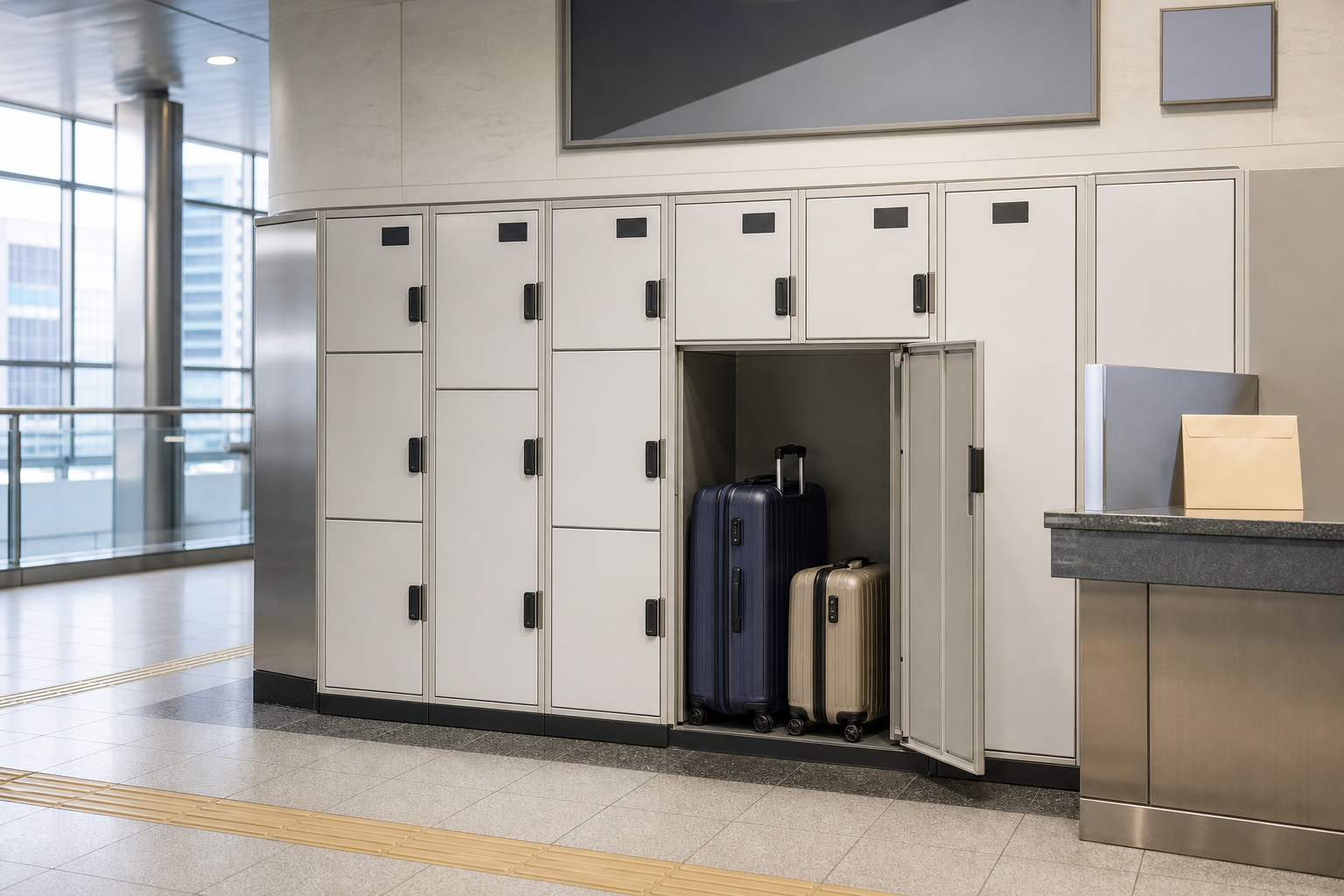
Choose between lockers, staffed counters, hotel storage and luggage forwarding around Nagoya Station using current official routes, costs and backups.
For a few hours near Nagoya Station, start with a coin locker only if your bag fits and you can return before the access area closes. Use a staffed counter when lockers are full, your suitcase is oversized, or you need a human to confirm pickup rules. Ask your hotel to hold luggage when you are checking in or out. Forward the suitcase to your next hotel or airport when carrying it would complicate a Shinkansen transfer, a day trip or travel with children.
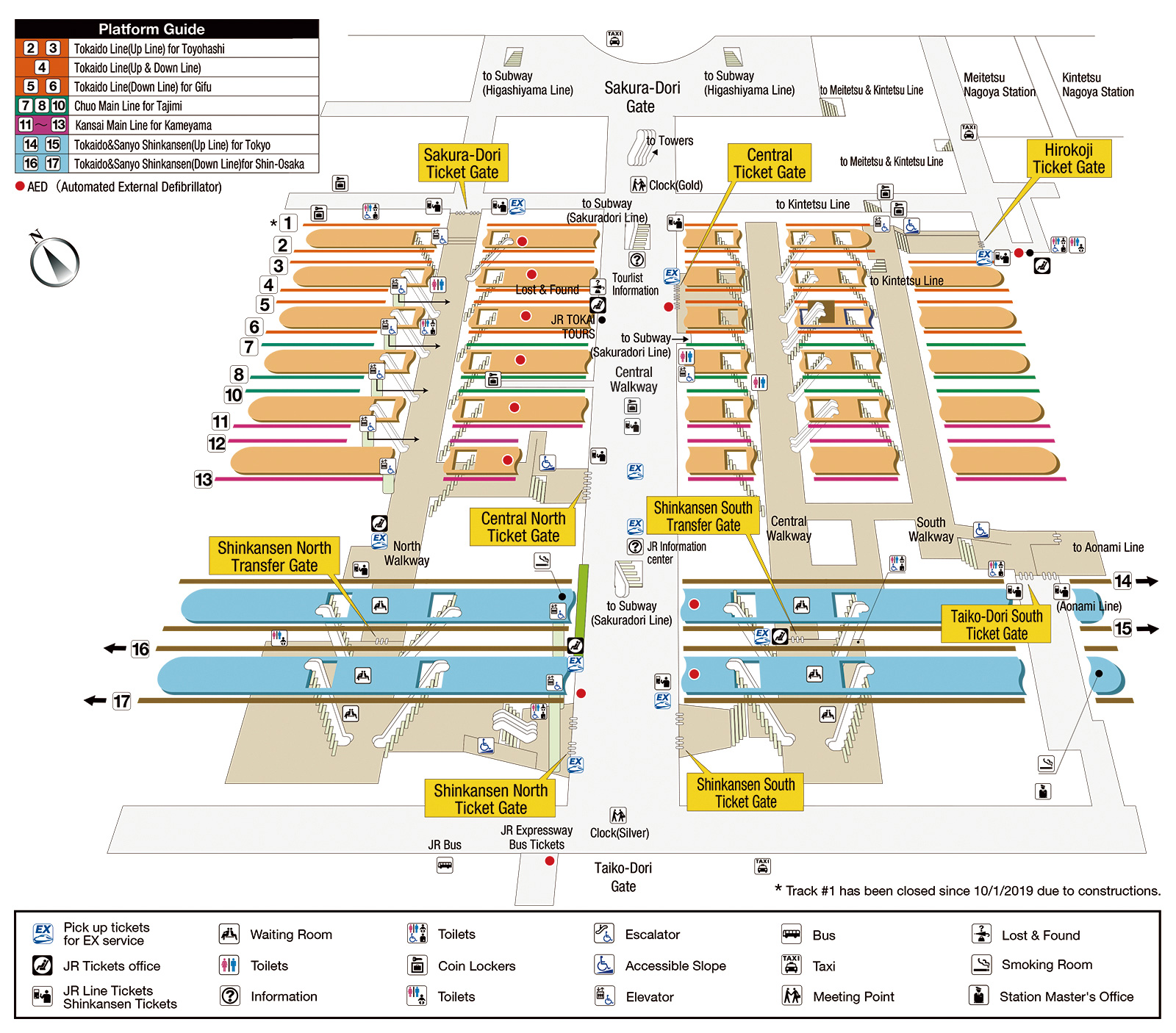
Nagoya Station is not one simple building. JR conventional lines and the Tokaido Shinkansen connect with Meitetsu, Kintetsu, the subway, JR Central Towers, JR Gate Tower and large underground passages. “A locker at Nagoya Station” is only useful if you record the operator, floor, nearby gate or elevator and closing time. A cheap locker on the wrong side of the complex can cost more in missed-train stress than a staffed counter near your return route.
Use this guide as a decision and routing tool rather than a promise that a particular locker will be empty. Locker inventory, prices, counter hours, parcel cutoffs and accepted items change. Confirm the live operator page on the day you travel.
Last checked and official source box
Last checked: August 3, 2026. Recheck every linked source before travel, especially during festivals, holiday weekends and other crowded periods.
Primary sources:
- JR Central official Nagoya Station layout map — use the current station diagram to orient yourself around JR and Shinkansen gates and service symbols.
- Visit Nagoya: tourist information centers — official city listing for the Nagoya Station Tourist Information Center and the Yamato-operated Hands-Free Tourist Counter at Oasis 21.
- JR Nagoya Takashimaya official FAQ — current temporary-storage and JR Gate Tower locker information.
- Yamato Hands-Free Travel — official overview of temporary storage, hotel/airport delivery and service-counter search.
- Yamato help and support — current precautions, FAQs and English support details.
- Centrair delivery and baggage service — official airport delivery in both directions.
- Centrair same-day baggage delivery — same-day airport-to-accommodation service for eligible hotels around Nagoya Station, Sakae and Nishiki, subject to exclusions and current cutoff rules.
- JR Central oversized-baggage rules — reservation requirement for baggage with total dimensions over 160 cm on the Tokaido Shinkansen.
JR Nagoya Takashimaya’s current FAQ says the department store itself has no coin lockers but offers temporary storage at the Takashimaya Service Counter on the north side of the North Block Delicious Court on the first floor. It separately lists 39 lockers near the north elevator on the second floor of JR Gate Tower, accessible from 7:00 a.m. to 11:00 p.m., with listed prices from ¥500 to ¥1,500 depending on size. Treat those details as a current source snapshot, not a permanent guarantee.
Visit Nagoya currently lists the Nagoya Station Tourist Information Center in the JR Nagoya Station Central Concourse, open 8:30 a.m.–7:00 p.m. except its stated year-end closure. The same city page lists an Oasis 21 Hands-Free Tourist Counter managed by Yamato: luggage acceptance 10:00 a.m.–5:00 p.m., pickup until 8:00 p.m., with listed pre-tax storage prices of ¥500 for medium and ¥800 for large. Oasis 21 is in Sakae, not Nagoya Station, so it is a fallback for a Sakae day rather than a last-minute station locker.
Quick decision table: locker, counter, hotel or forwarding?
| Your situation | Best first option | Why | Main constraint |
|---|---|---|---|
| Small or medium bag, same-day return to the station | Coin locker | Fast, private and usually no paperwork | Size, availability, payment method and access hours |
| Large suitcase or lockers full | Staffed temporary-storage counter | Human can confirm acceptance and pickup | Counter hours, capacity, ID/receipt rules |
| Checking in later or leaving after checkout | Your hotel | Often the least complicated handoff | Property policy and same-day guest status |
| Day trip before moving to another city | Forward to next hotel | Avoids returning to Nagoya Station only to collect a bag | Delivery lead time and hotel acceptance |
| Flying from Centrair after a Nagoya stay | Forward to airport early | Removes baggage from the rail transfer | Airport deadline, terminal/flight details and buffer days |
| Arriving at Centrair and going to a Nagoya hotel | Eligible same-day airport delivery | Lets you enter the city hands-free | Hotel eligibility, cutoff and current service conditions |
| Oversized bag boarding the Tokaido Shinkansen | Reserve the correct oversized-baggage seat or forward it | JR Central requires special reservation above the stated dimension threshold | Train reservation and bag measurement |
| Valuables, medicine, passport or fragile electronics | Keep them with you | Storage/delivery convenience is not worth loss or access risk | Smaller personal day bag required |
Default sequence: hotel first if you are a guest; locker second for a short same-day stop; staffed counter if size or availability fails; forwarding when the route would otherwise require a return or difficult train transfer.
Three measurements to take before leaving home
Write these in your phone:
1. External suitcase dimensions: length + width + height, including wheels and handles.
2. Approximate weight: forwarding counters and transport rules can use weight as well as dimensions.
3. Must-carry inventory: passport, wallet, medication, power bank, keys, tickets, irreplaceable documents and fragile devices.
Do not assume a suitcase marketed as “large” matches a locker category called “large.” The opening shape and depth matter. A soft bag may compress; a rigid suitcase will not. If several bags must fit, compare the total price of multiple lockers with one staffed-storage or forwarding transaction.
For the Tokaido Shinkansen, JR Central says baggage with total external dimensions greater than 160 cm requires a seat with an oversized-baggage area. Measure before travel; a storage plan for Nagoya does not solve the next train’s reservation rule.
Nagoya Station route cards
Route card A: arriving by Tokaido Shinkansen
1. Before leaving the platform area, check the official JR Central Nagoya Station map and identify the gate you will use.
2. Photograph the gate name and one fixed landmark before searching for storage.
3. If you will return for another Shinkansen, prioritize storage on a route you can retrace without crossing the entire complex.
4. Check locker size and access time before paying.
5. Save the locker bank, number, payment method and retrieval code or key in two places.
6. Return with at least 30 minutes of station buffer; allow more during holidays or with children.
Do not write only “Nagoya locker” in your notes. Record something reproducible, such as “JR Gate Tower, 2F, north elevator, locker number, paid by IC card.”
Route card B: using JR Gate Tower or Takashimaya
The JR Nagoya Takashimaya FAQ currently provides two distinct options:
- JR Gate Tower lockers: 39 units near the north elevator on the second floor, listed access 7:00 a.m.–11:00 p.m.; current listed price ¥500 small, ¥900 medium, ¥1,300 large/special-medium and ¥1,500 extra-large.
- Takashimaya Service Counter: temporary luggage storage on the first floor, north side of the North Block Delicious Court; consult the linked FAQ for current service conditions.
These are not interchangeable. A locker may remain accessible longer but can be full or too small. The counter can handle a conversation about the bag but follows staffed hours and acceptance rules. Check the exact collection deadline before walking away.
Route card C: Nagoya Station Tourist Information Center
Visit Nagoya places the center in the JR Central Concourse and currently lists 8:30 a.m.–7:00 p.m. hours, except December 29–January 1. Use it to confirm current city-approved baggage services, wayfinding and alternatives when your first locker bank is full. Do not assume the information-center opening time equals the retrieval deadline of a separate locker or commercial counter.
Route card D: Sakae and Oasis 21 fallback
If your actual sightseeing day is in Sakae, carrying the bag from Nagoya Station to Oasis 21 may still be rational when station options fail. Visit Nagoya currently lists the Yamato-managed Hands-Free Tourist Counter at Oasis 21 with acceptance 10:00 a.m.–5:00 p.m. and pickup until 8:00 p.m. Confirm same-day pricing and availability on the official city page.
This is not a good fallback if you need to board a near-term Shinkansen from Nagoya Station. It adds a subway trip and a fixed retrieval deadline.
Coin-locker checklist: pay, store and retrieve without mistakes
Before paying:
- confirm the locker is in a public area you can access when returning;
- check the displayed retrieval deadline and maximum storage period;
- verify accepted payment—coins, cash, transport IC card or another method;
- test that every wheel and handle clears the opening;
- inspect the compartment for damage or abandoned items;
- read what happens if the locker exceeds its permitted period.
After locking:
- pull the door once to confirm it latched;
- photograph the locker bank, number and nearest fixed sign;
- save any PIN, receipt or key securely;
- note which IC card was used if the card becomes the retrieval key;
- set two alarms: “start return” and “collect luggage”;
- keep train tickets, passport and medication outside the locker.
If retrieval fails, do not force the door. Use the operator contact printed on the locker bank or ask station staff. Different locker banks can have different operators, even within the same station complex.
The MANACA, Suica and ICOCA guide explains why a major IC card may work for payment, but card acceptance is not guaranteed at every locker. Carry a second payment method using the Nagoya cash and ATM guide.
Staffed storage checklist
Ask these questions before handing over the bag:
1. What is the latest collection time today?
2. Is overnight storage allowed, and how is an extra day charged?
3. Are size, weight or bag-count limits enforced?
4. Which items are prohibited or excluded from compensation?
5. Is identification required at drop-off or pickup?
6. Can someone else retrieve the bag, and what proof would they need?
7. What happens if a train delay makes me late?
8. Is the counter in the same building and floor where I will return?
Photograph the claim receipt but keep the original. Verify that the bag count and any visible damage are recorded. Never place passports, medicine, cash, jewelry, batteries requiring special handling, fragile electronics or irreplaceable documents into temporary storage unless the operator explicitly accepts them and you are comfortable with the terms.
Luggage forwarding: when it beats station storage
Forwarding is usually the better operation when you would otherwise return only to collect a suitcase, when changing hotels by rail, or when managing children, stairs and crowded platforms. Yamato describes Hands-Free Travel as temporary storage plus parcel delivery to hotels or airports through participating counters.
Hotel-to-hotel forwarding card
1. Ask the current hotel whether it can send luggage and whether the next hotel accepts deliveries for guests.
2. Confirm the next reservation name, address, phone number and check-in date exactly.
3. Ask for the actual delivery date—not only an estimated number of days.
4. Build at least one buffer day when delay would damage the trip.
5. Keep one change of clothes, medication, chargers, documents and essentials in a day bag.
6. Retain the waybill and tracking information until receipt.
Private lodgings, unmanned properties and some apartment-style stays may not accept deliveries. Confirm with the recipient before sending.
Nagoya-to-Centrair forwarding card
Centrair officially says baggage can be delivered from locations in Japan to the airport, with details such as final collection date and charges depending on the delivery company and departure. Use a conservative buffer and verify:
- airport code and terminal;
- airline, flight number, date and departure time;
- exact airport counter and business hours;
- earliest pickup time;
- sender cutoff date;
- identification and waybill needed for collection.
Do not send passports, flight documents, medication or everything needed for the final night. Weather and traffic can delay delivery; Yamato publishes a specific delay precaution for these risks.
Centrair-to-Nagoya same-day delivery card
Centrair’s official page currently offers same-day delivery to eligible hotels around Nagoya Station, Sakae and Nishiki, excluding some locations. Check the live cutoff, price, eligible property and arrival time before handing over the bag. If your flight lands late, use the normal delivery/storage counter or carry the bag using the Centrair-to-Nagoya transport guide.
Full-cost and time calculator
A locker is not automatically cheapest once backtracking is counted.
Locker total
Locker fee × number of compartments × charged periods + payment friction + return-trip time
Staffed storage total
Bag fee × number of bags × charged days + walking time + closing-time risk
Forwarding total
Delivery fee by size/route + counter travel + buffer-night essentials + possible packaging
Estimate the value of backtracking:
Backtrack burden = round-trip minutes + extra transport fare + missed-connection risk
If a family needs three lockers and must spend 50 minutes returning across Nagoya Station, forwarding may be better even when its cash price is higher. Conversely, sending one cabin bag for a three-hour stop is usually unnecessary.
| Option | Cash cost | Time cost | Capacity risk | Deadline risk | Best use |
|---|---|---|---|---|---|
| Coin locker | Low to medium | Low if on route | High on busy days | Locker-area access | Short same-day stop |
| Staffed counter | Medium | Queue and wayfinding | Medium | Staffed closing time | Large/full-locker fallback |
| Hotel hold | Often low | Lowest if on route | Property-specific | Reception policy | Check-in/check-out day |
| Forwarding | Medium to high | Lowest after drop-off | Acceptance rules | Delivery delay | Multi-city or airport transfer |
Peak-period and failure plan
Lockers fill fastest when many travelers arrive before hotel check-in, during major events and on holiday weekends. Build a three-level fallback before reaching the station:
- Plan A: your chosen locker bank or hotel.
- Plan B: a named staffed counter with verified hours.
- Plan C: forwarding or a second district-specific counter that still fits your route.
Do not create a plan C that closes before you can return. Check live event pressure and leave a larger station buffer in August heat; hauling bags through long passages is slower than the map suggests.
Scam warning: use lockers, hotel desks and counters identified by official station, city, airport, department-store or delivery-operator sources. Do not hand a suitcase, passport copy or payment to a person merely claiming to run an overflow service near the station. Confirm the business name, receipt, retrieval terms and fixed location.
FAQ
Are there coin lockers at Nagoya Station?
Yes, the broader station complex has locker options. JR Nagoya Takashimaya currently lists 39 units near the north elevator on the second floor of JR Gate Tower. Other banks may exist under different operators. Use the official station map and on-site signs, then record the exact bank and retrieval rules.
How much are lockers near Nagoya Station?
The current JR Nagoya Takashimaya FAQ lists its JR Gate Tower units from ¥500 for small to ¥1,500 for extra-large, with intermediate sizes at ¥900 and ¥1,300. Prices elsewhere can differ. Verify the machine display before paying.
What if every large locker is full?
Try a staffed storage counter, your hotel or forwarding rather than searching randomly through the whole station. JR Nagoya Takashimaya lists a temporary-storage counter on its first floor; the city tourist information center can help confirm current alternatives.
Can my hotel hold luggage before check-in or after checkout?
Many hotels do, but it is a property policy rather than a universal right. Ask the specific hotel, give your reservation name and confirm same-day pickup. Our where to stay in Nagoya guide helps compare whether a station-area hotel reduces luggage transfers.
Can I send luggage from Nagoya to my next hotel?
Often, through a hotel or participating delivery counter. Confirm the receiving hotel accepts guest luggage, use the exact reservation name and allow enough lead time. Keep essentials with you.
Can I send luggage to Centrair Airport?
Centrair officially supports airport-bound delivery through service providers. Confirm the sender cutoff, counter, terminal, flight details and pickup hours. Send early enough to absorb weather or traffic delay.
Can Centrair deliver my bag to a Nagoya hotel the same day?
The airport currently advertises same-day delivery to eligible hotels around Nagoya Station, Sakae and Nishiki, with exclusions. Check the current cutoff and whether your specific property participates.
Do I need a special Shinkansen seat for a large suitcase?
JR Central requires a seat with an oversized-baggage area when the total of length, width and height exceeds 160 cm on the Tokaido Shinkansen. Measure the exterior, including wheels and handles, and reserve correctly.
What should never go into storage or forwarding?
Keep passports, money, payment cards, medication, keys, tickets, fragile/irreplaceable devices and everything needed before the expected delivery. Follow each operator’s prohibited-item and compensation terms.