Sakae Area Guide: A Practical Base for Central Nagoya
A practical guide for international travelers on sakae area guide nagoya, covering the best next steps, tradeoffs, and when to call a pro.
A practical guide for international travelers on sakae area guide nagoya, covering the best next steps, tradeoffs, and when to call a pro.
Sakae is Nagoya’s most useful all-round downtown base: the subway, department stores, restaurants, nightlife, parks, and several easy sightseeing stops meet within a compact grid. It is not the best choice for every traveler—Meieki is simpler for early trains and day trips—but Sakae wins when you want evenings to remain walkable after the major attractions close.
This guide covers the visitor zone from Hisaya-odori Park and Oasis 21 west to the retail core, then south-west toward Shirakawa Park. Most stops are 5–20 minutes from Sakae Station; crowds and summer heat can extend that.
> Current-source check — checked July 31, 2026
>
> - Nagoya’s official visitor bureau describes Sakae as the city-center district around Hisaya-odori Park, MIRAI TOWER, and Oasis 21. Confirm events and temporary closures at Visit Nagoya.
> - Oasis 21 is directly connected to subway Sakae Station and Meitetsu Sakaemachi Station; its official site identifies it as a transport hub with a bus terminal. Check the official Oasis 21 site before visiting the rooftop, since operating access can change in bad weather.
> - Nagoya city bus rides have a flat ¥210 adult fare according to Visit Nagoya’s official transport guide. Subway fares vary by distance; use the Nagoya Transportation Bureau ticket page for current pass prices and conditions.
> - Attraction hours, observation-deck admission, exhibitions, and seasonal illuminations change. Use the linked official attraction pages rather than treating an old screenshot or blog price as final.
Is Sakae the right Nagoya base for you?
| Choose Sakae if… | Choose Meieki instead if… | Consider Fushimi if… |
|---|---|---|
| You want restaurants, shopping, nightlife, and a post-dinner walk close to the hotel | You have an early Shinkansen, airport train, or several rail day trips | You prefer quieter evenings between Sakae and Nagoya Station |
| You expect to use both the Higashiyama and Meijo subway lines | You carry large luggage and want the fewest transfers | You want walkable access to Shirakawa Park and the museum zone |
| Oasis 21, MIRAI TOWER, and Hisaya-odori Park are priorities | You value transport efficiency above atmosphere | You are comfortable with fewer late-night choices immediately outside the hotel |
| You enjoy a lively urban center after dark | Crowds and nightlife noise bother you | You want a business-district feel rather than a retail core |
Our fuller Where to Stay in Nagoya comparison explains the tradeoffs by trip style. For first-time visitors with one evening and one full city day, Sakae is usually the most enjoyable base. For three day trips and little city sightseeing, Meieki is usually more efficient.
Sakae orientation: know these four anchors
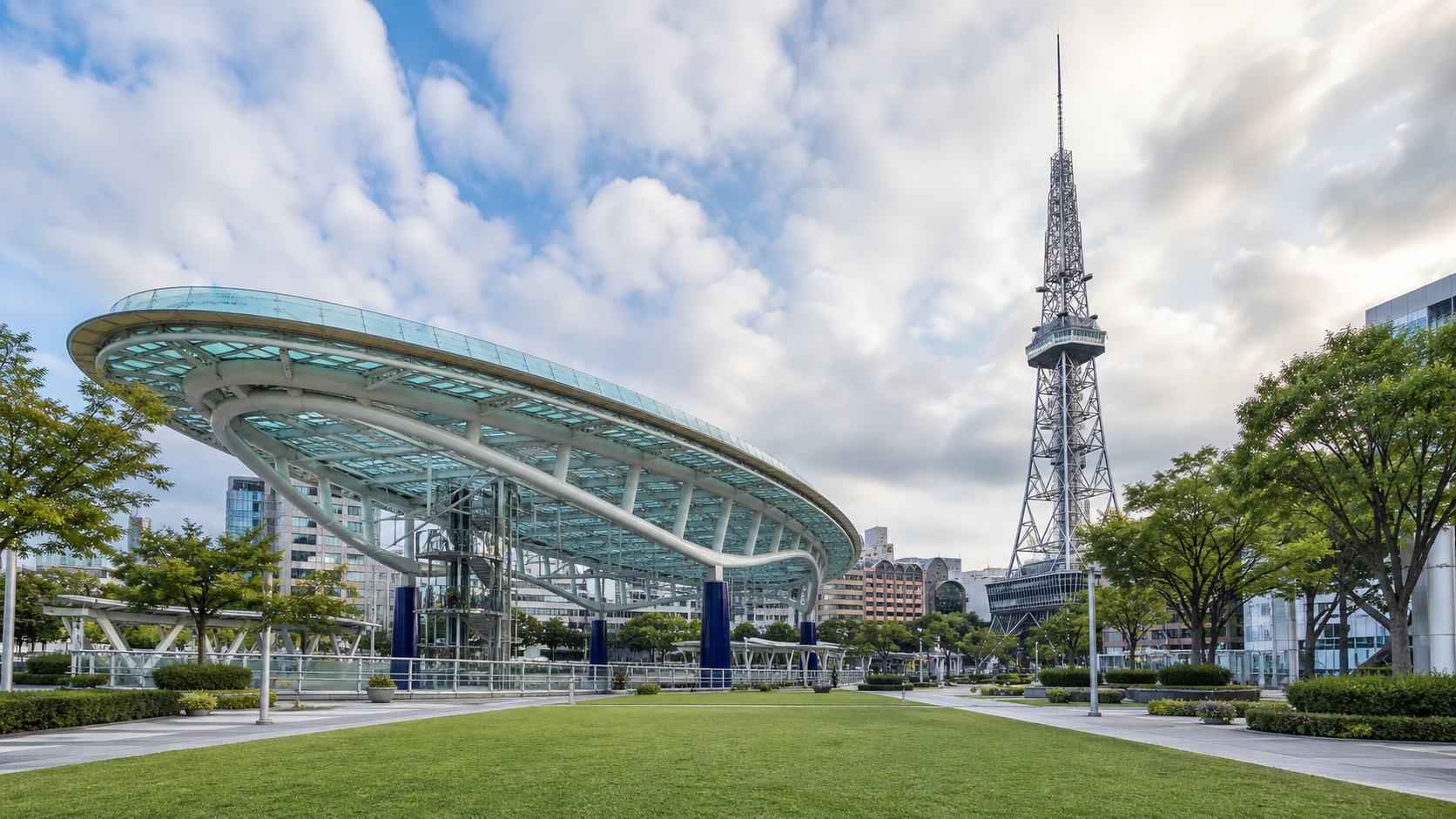
Sakae Station is the transport anchor, served by the Higashiyama and Meijo subway lines. Oasis 21 sits east of the station complex and connects to Sakaemachi Station and the bus terminal. Hisaya-odori Park and MIRAI TOWER form the long north–south green spine. Shirakawa Park, home to the science and art museums, lies south-west toward Fushimi rather than directly beside Sakae Station.
Do not navigate by exit number alone. Match the destination on the station map, then confirm the final block before climbing the stairs. Elevator routes may be longer.
<!-- route-map:v2 {"title":"Sakae orientation walk","summary":"A practical central-Nagoya loop linking the station, rooftop park, tower, Hisaya-odori Park and Shirakawa Park.","center":{"lat":35.1681,"lng":136.9057},"zoom":14,"mode":"walking","stops":[{"name":"Sakae Station","lat":35.1696,"lng":136.9081,"note":"Start on the Higashiyama or Meijo subway lines."},{"name":"Oasis 21","lat":35.1707,"lng":136.9091,"note":"Rooftop landmark, visitor information and bus terminal."},{"name":"Chubu Electric Power MIRAI TOWER","lat":35.1723,"lng":136.9084,"note":"Observation decks in Hisaya-odori Park; admission and hours vary."},{"name":"Hisaya-odori Park","lat":35.1704,"lng":136.9084,"note":"Landscaped pedestrian spine with shops and places to pause."},{"name":"Shirakawa Park","lat":35.1651,"lng":136.8998,"note":"Science museum and art museum zone; allow about 15–20 minutes from Sakae."}]} -->
Getting to Sakae without unnecessary transfers
From Nagoya Station
Take the Higashiyama subway line from Nagoya to Sakae. It is the straightforward two-stop route and normally takes only several minutes on the train; allow extra time to reach the subway platform inside the much larger Nagoya Station complex. Buy a normal ticket or tap a compatible IC card. If you have luggage, do not choose a bus merely to avoid stairs—the subway is usually clearer and more frequent, and elevators are available when you follow station accessibility signs.
Route card: Nagoya Station → Sakae
| Step | Action | Planning allowance |
|---|---|---|
| 1 | Follow Higashiyama Line signs at Nagoya Station | 5–12 min inside the station |
| 2 | Board toward Fujigaoka and ride to Sakae | About 5 min on-train |
| 3 | Match your hotel or attraction to the station map before exiting | 5–10 min |
Open the route in Google Maps. Treat the app’s platform and departure time as live guidance, not this article’s estimate.
From Chubu Centrair Airport
Take Meitetsu to Meitetsu Nagoya, then transfer to the Higashiyama subway line for Sakae. With a suitcase, allow generous transfer time. Our Centrair to Nagoya guide covers the airport train choices, luggage logic, and transfer risks in detail.
By city bus
Oasis 21 contains a major bus terminal, and Visit Nagoya states that city bus fare is a flat ¥210 for adults. Buses can be useful for a direct destination, but the subway is generally easier for a first arrival with bags. The city-center C-758 loop links Nagoya Station, Sakae, and Osu during daytime service; verify its current stops and operation on the Transportation Bureau’s official C-758 page.
A realistic half-day Sakae walking plan
This route works best from late afternoon into evening and avoids pretending that every nearby attraction fits into one session.
| Time | Stop | What to do | Cost logic |
|---|---|---|---|
| 15:00 | Oasis 21 | Walk the public levels, check the visitor information counter, and photograph the roof structure | Public spaces are generally free; confirm rooftop access |
| 15:45 | Hisaya-odori Park | Walk north through the landscaped park and pause for coffee | Free unless you buy food |
| 16:30 | MIRAI TOWER | Choose the paid observation deck only if visibility is good | Check current hours and admission before queuing |
| 18:00 | Sakae retail core | Browse one department store rather than several | Free to browse |
| 19:00 | Dinner | Pick one Nagoya specialty and retain a backup restaurant | Budget roughly by menu, not online “from” prices |
| 20:30 | Oasis 21 or park | Return for the night lighting, weather permitting | Free public-space option |
For a compressed city-wide route that combines Sakae with other neighborhoods, use our Nagoya one-day itinerary. Do not bolt a long museum visit onto the half-day plan: the science museum can consume most of a morning or afternoon, particularly if you want a planetarium session.
What is genuinely worth your time?
Oasis 21: best free orientation stop
Oasis 21 connects the “Spaceship-Aqua” rooftop, lawn, event space, shops, stations, and bus terminal. Start here to orient yourself, find visitor information, and judge whether the weather justifies a tower ticket.
Allow 30–45 minutes without an event. In heavy rain, high wind, or extreme heat, check access notices before planning around the rooftop.
Hisaya-odori Park: best urban pause
The park is the area’s visual spine rather than a conventional fenced garden. It is useful for a low-pressure walk between the tower, shops, cafés, and northern Sakae. Allow 30–60 minutes depending on stops.
MIRAI TOWER: best for a clear-day overview
Chubu Electric Power MIRAI TOWER offers elevated city views from observation spaces approximately 90 and 100 meters high, according to Visit Nagoya’s official attraction page. The editorial choice is simple: pay when visibility is good or when the illuminated night view matters to you; skip it in haze, heavy rain, or a tight budget. Check the tower’s official notice linked from the visitor-bureau page for that day’s hours, ticket price, and temporary closure information.
Shirakawa Park museums: best for families or rain
Shirakawa Park is a separate mini-zone between Sakae and Fushimi. The Nagoya City Science Museum is the stronger choice for interactive family time; the Nagoya City Art Museum suits visitors prioritizing exhibitions. Check each museum’s official calendar before walking over—regular closure rules and exhibition schedules can leave a beautifully planned route facing a locked door. If the planetarium matters, investigate its current ticket procedure before arrival rather than assuming every session has walk-up space.
Department stores and underground streets: best weather backup
Sakae’s retail concentration makes it resilient in rain, summer humidity, or winter wind. The mistake is attempting every mall. Choose one department store for food halls and gifts, then use the underground network to reach the next planned stop.
Food strategy: one specialty, one backup
Famous branches queue at dinner, so choose the dish before the restaurant:
- Miso katsu: a rich red-miso sauce over pork cutlet; confirm sauce style and portion before ordering.
- Tebasaki: seasoned chicken wings, usually easier to share in an izakaya setting.
- Hitsumabushi: grilled eel served in stages; higher-cost and often slower, so reserve time and check the restaurant’s last order.
- Kishimen: broad, flat noodles; a useful lighter or faster option.
If eel is your priority, our Nagoya hitsumabushi guide explains ordering and queue strategy. At any popular restaurant, save a second nearby option and walk away if the quoted wait breaks the rest of your evening.
Sakae practical checklist
Use marked crossings, follow station staff and posted closure instructions, and do not enter a rooftop or observation area closed for wind or severe weather. Check any current travel advisory, severe-weather or natural-disaster guidance from your government and Japan’s official authorities before travel; contact your embassy or consulate if you need consular help. In an emergency, call 110 for police or 119 for ambulance/fire; hotel or station staff can help communicate your location.
- [ ] Save your hotel name and address in Japanese as well as English.
- [ ] Check the correct Sakae Station exit or elevator route before leaving the paid area.
- [ ] Verify MIRAI TOWER, museum, and rooftop access on official sites that morning.
- [ ] Keep one indoor replacement for rain, heat, or a closure.
- [ ] Decide whether a normal IC-card fare or a day ticket matches the day’s actual rides.
- [ ] Reserve or shortlist dinner; do not depend on a single famous branch.
- [ ] Store large luggage before beginning the walking loop.
- [ ] Save the last subway time and hotel route before nightlife.
- [ ] Carry a small amount of cash even if most planned stops accept cards.
FAQ
Is Sakae walkable?
Yes for its central attractions. Oasis 21, MIRAI TOWER, Hisaya-odori Park, and the retail core form a compact walking zone. Shirakawa Park is farther south-west; allow roughly 15–20 minutes and more in heat, crowds, or when navigating underground.
Is Sakae better than Nagoya Station for first-time visitors?
Sakae is usually better for dining, shopping, nightlife, and an enjoyable evening. Nagoya Station is better for airport transfers, Shinkansen travel, and multiple rail day trips. A first-timer spending most time inside Nagoya often gets more from Sakae.
Do I need a transit pass?
Not automatically. If you only ride Nagoya Station–Sakae and return, normal fares or an IC card may cost less than a pass. Compare your actual planned rides with the current official pass price and validity rules.
The editorial verdict
Sakae works because it lets the day end naturally. You can move from a museum or shopping stop to a park, dinner, and a lit-up city landmark without another major transfer. Make it your base when city life is the priority; choose Meieki when rail logistics dominate. Keep paid viewpoints and outdoor rooftops conditional, verify official hours on the day, and build the route around one strong meal rather than a checklist of malls. That produces a better Sakae visit than trying to “complete” downtown Nagoya in a single rush.